The History and Evolution of Hybrid Algorithmic Trading Systems for NinjaTrader
In 2009, MicroTrends became the ninth NinjaTrader Ecosystem Vendor Partner and was later recognized as one of a small group of Certified NinjaScript Consultants operating worldwide, establishing a reputation as a leading algorithmic trading systems developer within the NinjaTrader community. MicroTrends is regarded as a pioneer of interactive hybrid algorithmic trading for NinjaTrader and developed proprietary indicators, bar types, trading frameworks, and execution technologies whose concepts later achieved broad adoption across the trading-software industry. Elements of these methods and technologies influenced developers and or powered subsequent vendor products, although the original MicroTrends development lineage has not always been clearly acknowledged.
This article presents a MicroTrends Ltd perspective on the development of NinjaTrader algorithmic trading, interactive automation, automated trade management, hybrid trader controls, professional portfolio technology, and the publicly released commercial and white-label projects that contributed to the modern Algo Trading Systems ecosystem.
The development journey spans NinjaTrader 7 projects such as MTFramework, Easy Trader, MTDS7, NinjaBuddy, BWT Precision AutoTrader 7, Woodies AutoTrader 7, and Algo Futures Trader 7, followed by NinjaTrader 8 technologies including ATS QuadroBase, Alpha Pro Trader, Woodies AutoTrader 8, BWT Precision AutoTrader 8, Algo Futures Trader 8, AlphaWebTrader, AI-assisted trading tools, and the current Algo Trading Systems LLC trader-development environment.
From Early NinjaTrader Automation to the Modern ATS Trading Ecosystem
Hybrid algorithmic trading did not begin with AI or the latest generation of automated trading platforms. Within the MicroTrends and Algo Trading Systems development history, it evolved through nearly two decades of NinjaScript engineering, live trading, professional software development, commercial product delivery, white-label projects, portfolio-system research, and direct experience with retail, prop-firm, and professional trading requirements.
The central objective has remained consistent: combine the speed, precision, consistency, and repeatability of software with the market awareness, contextual judgment, risk control, and adaptability of a human trader.
That development path ultimately produced Algo Futures Trader for NinjaTrader automated trading, AlphaWebTrader market intelligence, the ATS AI Trading Copilot, the ATS VIP Trading Group, structured Fast Track onboarding, and the ATS VIP Mastery development program.
What Is a Hybrid Algorithmic Trading System?
A hybrid algorithmic trading system is a configurable operating model in which the trader and the software share control of the trading process. It is not limited to one fixed percentage of automation and does not force the trader to choose between completely manual trading and an unattended trading robot.
The trader can provide higher-timeframe context, directional bias, market-regime assessment, technical levels, news awareness, session selection, position sizing, risk limits, and permission to participate. The software can provide repeatable signal detection, precise order placement, automated stops and targets, OCO handling, scaling, break-even rules, trailing management, position monitoring, order management, and operational safety.
The balance between human and machine control can change according to the trader, strategy, market, account type, trading session, available capital, and objective. Hybrid operation can include manual entry with automated management, semi-automatic entry after trader authorization, long-only or short-only algorithmic operation, interactive automation, attended fully automatic trading, or advanced unattended portfolio operation.
The defining feature is the ability to place human judgment and algorithmic control at the most appropriate points within a structured and repeatable trading workflow.
MicroTrends Ltd: Institutional Experience, Retail Innovation
The MicroTrends Difference
MicroTrends was built on genuine financial-technology experience rather than theory, imitation, or repackaged ideas. . Click here to learn more about MicroTrends.
This institutional background provided the engineering discipline, financial-market understanding, and technical foundation behind MicroTrends. It represents decades of real-world experience building systems for demanding financial environments where reliability, accuracy, performance, and effective risk controls matter.
From the Financial District to Independent Innovation
After leaving the institutional financial sector, Tom exchanged the traditional City environment for independent development, international travel, and island life. MicroTrends allowed him to continue designing financial-market technology while concentrating on the retail trading community and developing practical tools for independent traders.
Rather than entering retail trading as an inexperienced vendor, MicroTrends brought institutional development standards into the NinjaTrader ecosystem. Over the years, tens of thousands of software licences were provided free of charge, helping traders access indicators, strategies, and trading technology that might otherwise have remained beyond their financial reach.
MicroTrends has been a longstanding believer in the NinjaTrader vision and its potential to make professional-grade trading technology more accessible. That same principle continues today: combine genuine experience, original development, and modern technology to help serious traders build the knowledge, tools, and structured processes needed to pursue their goals.
MicroTrends and ATS NinjaTrader Project History
2009: MicroTrends NinjaTrader Framework 6.5–7—The Birth of Hybrid Algorithmic Trading
The MicroTrends NinjaTrader Framework was the original MicroTrends trading product and the first product in the NinjaTrader 6.5 and NinjaTrader 7 ecosystem to combine an interactive graphical trading interface and real-time trade controls directly with an automated NinjaTrader strategy.
Before this development, traders generally had to choose between manual chart trading and a strategy operating automatically from fixed rules and settings. The MicroTrends framework introduced a new operating model in which the trader could interact directly with the strategy while it was running.
Through the integrated graphical user interface, the trader could control strategy participation, permit long or short trading, switch between manual, semi-automatic, and fully automatic operating modes, manage active trades, and respond to changing market conditions in real time. The algorithm provided consistent signal processing, order execution, and trade management, while the trader retained control over direction, participation, timing, and risk.
This combination of a human operator, an interactive trading GUI, and an automated NinjaTrader strategy marked the birth of hybrid algorithmic trading within the NinjaTrader ecosystem. It established the human-and-machine trading model that later evolved through MTDS7, Easy Trader, NinjaBuddy, Algo Futures Trader 7, ATS QuadroBase, and the modern Algo Futures Trader 8 hybrid algorithmic trading platform.
The original framework established a principle that continued through later MicroTrends and ATS systems: traders should not be forced to choose only between completely manual execution and an unattended black-box strategy.
2010: MicroTrends Trading Development System 7
MicroTrends Trading Development System 7, commonly known as MTDS7, expanded the original framework into a reusable commercial unmanaged strategy engine. It supplied a foundation for building NinjaTrader 7 systems with professional order management, visual controls, entry filters, trade-management logic, and semi-automatic or fully automatic operation.
MTDS7 allowed new commercial strategies and client products to be developed without recreating the complete order engine, position logic, trade-management controls, and operator interface for every individual project.
Easy Trader and NinjaBuddy Interactive Controls
Easy Trader and NinjaBuddy extended the interactive trader-control concept. Rather than limiting automation to fixed strategy parameters configured before startup, these tools explored how a trader could authorize, filter, pause, modify, and supervise algorithmic behaviour during a live trading session.
The NinjaBuddy concept remains visible in later AFT technology through real-time controls for selecting algorithms, setting long or short permissions, approving opportunities, managing active positions, pausing execution, and overriding automation when required.
Licensed, Bespoke, and White-Label NinjaTrader Projects
MicroTrends also developed licensed, bespoke, and white-label NinjaTrader projects for external trading vendors and communities. These systems could combine a MicroTrends trading engine with a client’s indicators, signals, methodology, branding, education, configuration panels, and market approach.
The projects demonstrated how a reusable algorithmic framework could support different specialist trading methods while retaining consistent order handling, automated trade management, visual position control, and hybrid trader interaction.
BWT Precision AutoTrader for NinjaTrader 7
The original BWT Precision AutoTrader for NinjaTrader 7 was a Blue Wave Trading white-label project derived from MTDS7 technology and combined with Blue Wave Trading indicators, entry methods, market methodology, configuration controls, and visual styling.
The delivered system included a BWT-branded strategy base, trade manager, profit-and-loss display, order and position visualization, session logic, trend tools, and interactive hybrid controls. It was particularly suited to an attended man-and-machine workflow in which the trader controlled direction and participation while the software managed execution and the active position.
Woodies AutoTrader and Other Specialist Projects
Related NinjaTrader 7 and NinjaTrader 8 development included Woodies AutoTrader, Alpha Pro Trader, and other specialist projects that applied MicroTrends framework technology to independently defined trading methodologies. These projects contributed further experience in converting discretionary market concepts into structured algorithmic signals, filters, interfaces, and automatic trade-management workflows.
2017 Onward: Professional Portfolio and Unattended Automation Research
From 2017 onward, MicroTrends development expanded beyond individual retail strategy products into professional futures portfolio technology. This work focused on multi-system architecture, startup and continuation, persistent state, order and position recovery, fault tolerance, contract rollover, capital allocation, portfolio control, and the operational requirements of running algorithmic trading systems for extended periods.
This research exposed the difference between a basic strategy that can place automatic trades and a complete operational system capable of managing platform restarts, disconnections, broker responses, order anomalies, position mismatches, partial fills, data problems, contract changes, and other real-world events.
The engineering completed during this period became an important foundation for Algo Futures Trader 8.
2018: Algo Futures Trader 7
Algo Futures Trader 7 brought earlier MicroTrends hybrid concepts into a more complete real-time NinjaTrader 7 trading product. AFT7 was designed around interactive algorithmic trading, allowing the trader to start, stop, continue, filter, authorize, and supervise automated activity while retaining structured entry and trade-management logic.
AFT7 supported multiple algorithms, multiple timeframes, trend and breakout methods, news and OCO trading concepts, manual intervention, semi-automatic entries, fully automatic entries, and automated trade management.
Unlike a conventional strategy-only approach, AFT7 used deeper NinjaTrader API technology to improve flexibility, continuation, and operational control. It became the direct conceptual predecessor of AFT8 and reinforced the ATS principle that automation should support the trader rather than force every trader into unattended operation.
ATS QuadroBase for NinjaTrader 8
The transition from NinjaTrader 7 to NinjaTrader 8 required a new architectural foundation. ATS QuadroBase, also represented through the ATSQuadroStrategyBase implementation, provided an unmanaged NinjaTrader 8 strategy framework for algorithmic execution, hybrid controls, historical testing, optimization, entry logic, and automatic trade management.
QuadroBase separated reusable order-management and trading-engine functions from strategy-specific entry rules. Developers could create new systems on top of the framework without recreating the complete unmanaged order engine for every strategy.
The framework supported market, stop-market, stop-limit, and limit order workflows where compatible, together with automated targets and stops, long and short permissions, manual interaction, entry filtering, position visualization, and custom NinjaScript rules.
MicroTrends made the core QuadroBase strategy framework available through its public NinjaTrader 8 and ATS QuadroBase GitHub repository, providing developers with a technical example of the architecture used behind later projects.
BWT Precision AutoTrader for NinjaTrader 8
BWT Precision AutoTrader for NinjaTrader 8 was a complete standalone NinjaTrader 8 strategy-based trading system developed as a white-label commercial project for Blue Wave Trading.
The system was powered by the MicroTrends ATS QuadroBase architecture. QuadroBase supplied the unmanaged strategy engine, hybrid manual and automatic controls, order handling, position management, automated stops and targets, trade-management functions, visual components, and extensible technical foundation.
The completed BWT NT8 product combined Blue Wave Trading signals, filters, trend methods, breakout concepts, visual tools, session logic, trade-management controls, and branded operating features within a complete NinjaTrader 8 strategy.
BWT NT8 represents a complete focused trading product within the boundaries of NinjaTrader’s strategy architecture. Algo Futures Trader 8 developed into a substantially wider environment by combining strategy components with additional NinjaTrader API-based execution, continuation, recovery, adaptive, portfolio, and fault-tolerant technologies.
| Area | BWT Precision AutoTrader NT8 | Algo Futures Trader 8 |
|---|---|---|
| Product type | Complete white-label NinjaTrader 8 strategy-based system | Advanced NinjaTrader 8 algorithmic trading and execution ecosystem |
| Technical foundation | Powered by ATS QuadroBase | Developed from QuadroBase concepts, AFT7 technology, and professional portfolio research |
| Primary scope | Blue Wave signals, filters, hybrid controls, and automatic management | Multiple algorithms, markets, trading modes, recovery systems, portfolio workflows, and adaptive controls |
| Execution architecture | NinjaTrader unmanaged strategy | Strategy components combined with deeper NinjaTrader API-based execution technology |
| Relationship | A complete specialist implementation of related framework technology | The broader modern ATS operating environment |
Algo Futures Trader 8: The Modern Hybrid Trading Environment
Algo Futures Trader 8 combined the hybrid operating principles of AFT7 with the professional automation, portfolio, continuation, and recovery technology developed through the MicroTrends research program.
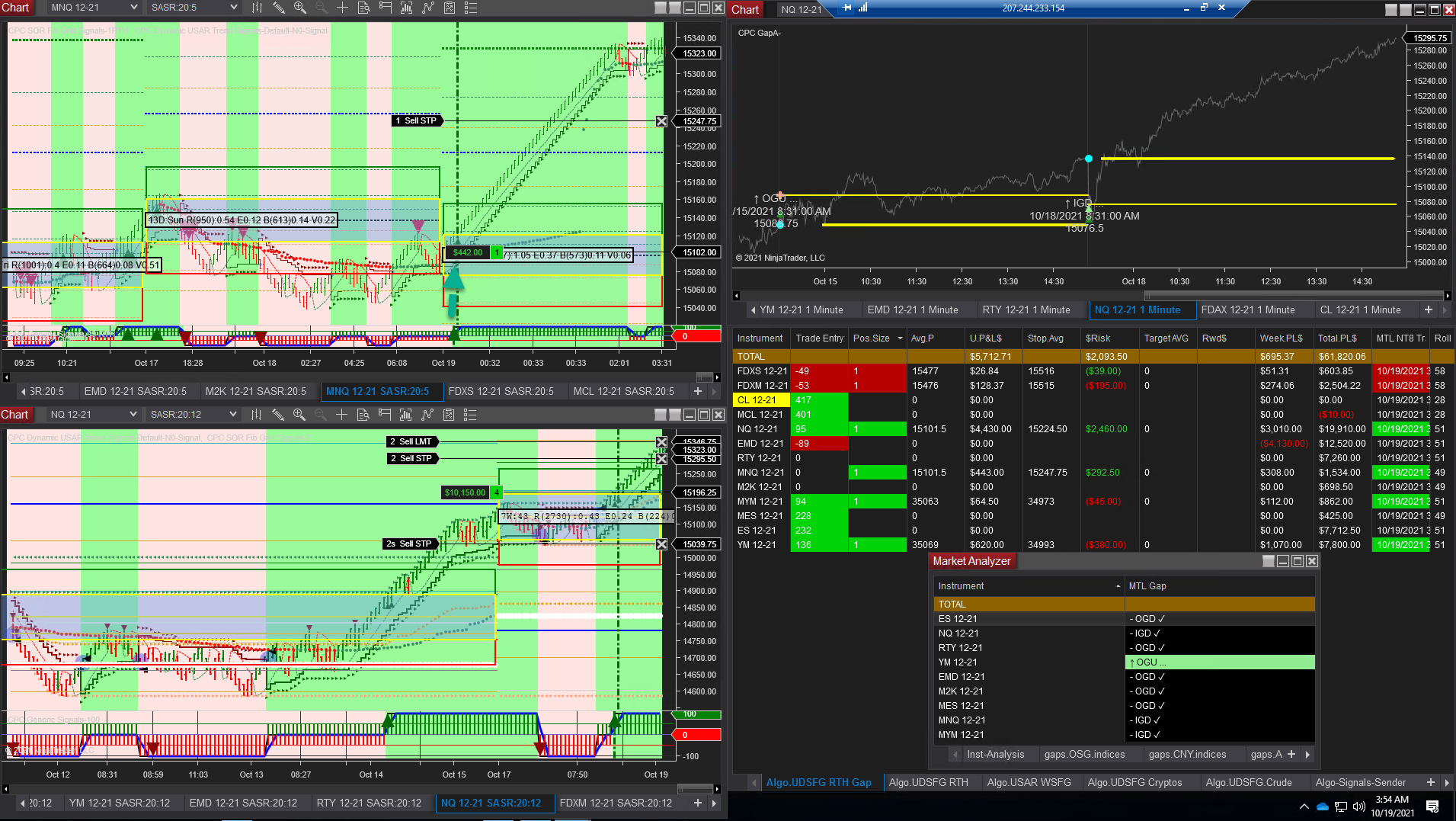
AFT8 was designed as more than a single NinjaTrader strategy or a switch-on-and-forget trading robot. Its dual-technology architecture can use NinjaTrader strategy components for historical testing, optimization, signal research, and development while applying deeper NinjaTrader API-based technology to advanced live execution and operational control.
This architecture supports manual trading with automatic management, semi-automatic entry, interactive hybrid operation, attended fully automatic trading, and advanced professional automation. A detailed explanation is available in the guide to automated trading systems for NinjaTrader 8.
Core AFT8 Trading and Execution Capabilities
- Manual, semi-automatic, interactive hybrid, and fully automatic trade-entry modes.
- Multiple algorithmic models and multiple-timeframe confirmation.
- Long-only, short-only, and two-direction operating controls.
- Market, stop-market, stop-limit, and limit entry methods where supported by the selected strategy and connection.
- Signal-based, rule-based, protective-order, and operator-controlled exits.
- Automated stops, profit targets, OCO handling, break-even rules, trailing logic, scale-outs, and emergency exits.
- Multiple entries, scaling in, scaling out, position building, and multiple-target management.
- Session start, pause, stop, restart, and continuation controls.
- Automatic startup with configured NinjaTrader workspaces and active platform sessions.
- Order and position rebinding, reconciliation, synchronization, and recovery after supported platform or connection events.
- Fault-tolerant safety controls designed to reduce the risk of unprotected or unmanaged positions.
- Multi-account, multi-instance, and supported trade-copying workflows.
- Adaptive bars, targets, stops, trend filters, strategy states, and optimization controls where enabled.
- Interactive NinjaBuddy controls for approving, filtering, pausing, modifying, and supervising algorithmic activity.
- Chart Trader integration for entries, exits, context, direction, and real-time operator decisions.
- Day-trading, prop-trading, swing-trading, intermediate-term, and portfolio configurations.
- Historical analysis, optimization, Market Replay, simulation, walk-forward development, and forward-testing workflows.
- Supplied algorithm baselines, templates, turnkey workspaces, filters, and trading-state starting points.
- User-defined NinjaScript signals and filters that can be connected to the AFT execution environment.
Traders can begin with supplied systems and workspace baselines or learn how to create custom NinjaTrader trading rules and connect them to AFT8.
Advanced Position Sizing and Capital Allocation
- Fixed position sizing or real-time operator-adjustable sizing.
- Capital and risk allocation by instrument, strategy, market, or independent trading stream.
- Classic retail percentage-based account allocation.
- Professional portfolio and fund-style allocation models.
- Fixed sizing, stepped sizing, controlled compounding, and operator-managed compounding.
- Real-time controls to increase, reduce, disable, or override trade size according to account and market conditions.
Professional Algorithm and Trade-Management Architecture
- Symmetrical or asymmetrical entry and exit sequences.
- Parallel operation of multiple algorithms and trade-management models.
- Selective activation of algorithms appropriate to current market conditions.
- Specialist single-market workflows or diversified multi-market portfolio operation.
- Hybrid controls combining algorithmic consistency with trader supervision, directional filtering, contextual decisions, and real-time risk adjustment.
AFT8 provides a configurable operating environment rather than forcing one strategy, one instrument, one timeframe, one trade manager, or one level of automation on every user. Traders can explore the broader platform at AlgoFuturesTrader.com.
Manual, Semi-Automatic, Hybrid, and Fully Automatic Trading Modes
| Trading Mode | Trader Responsibility | AFT8 Responsibility |
|---|---|---|
| Manual entry with automated management | Select the setup, direction, entry, session, and risk | Manage orders, stops, targets, scaling, trailing logic, and exits |
| Semi-automatic entry | Set the long or short bias and authorize the next qualifying opportunity | Detect the configured setup, execute the order, and manage the position |
| Interactive hybrid trading | Continuously supervise context, participation, direction, frequency, and account risk | Provide signals, precision execution, automated management, and repeatable controls |
| Attended fully automatic trading | Validate the system, remain present, monitor conditions, and intervene when required | Execute all qualifying trades permitted by the configured rules |
| Unattended fully automatic trading | Provide professional research, infrastructure, monitoring, diversification, and intervention procedures | Operate within defined models while monitoring and recovery systems manage technical events |
The highest available level of automation is not automatically the safest, most appropriate, or most profitable mode. AFT8 gives the trader control over how much decision-making is delegated to the software.
Hybrid Trading Versus Fully Automated Trading
Hybrid trading and fully automated trading solve different problems. Hybrid trading allows a trader to specialize in a market, session, workspace, or repeatable setup while applying human context to algorithmic signals. Fully automated trading attempts to represent every entry, filter, exception, risk decision, and operational response through objective programmed rules.
Potential Advantages of Hybrid Trading
- The trader can respond to scheduled announcements, unexpected news, abnormal volatility, poor liquidity, and changing market structure.
- Directional permissions can be aligned with higher-timeframe context rather than allowing every theoretical signal to trade.
- AFT8 can provide faster and more consistent order placement and trade management than manual clicking.
- Stops, targets, scaling, and exits can follow the prepared plan rather than fear, greed, or hesitation.
- Trade frequency can be controlled by authorizing only the next suitable opportunity.
- The trader can specialize in one instrument, one active session, and one repeatable process.
- The trader remains involved and can learn how the algorithms behave across different market states.
Limitations of Hybrid Trading
- The trader must be present, prepared, and capable of making consistent decisions.
- Poor discretionary filtering can reduce the effectiveness of an otherwise valid trading model.
- The operator can still overtrade, chase losses, change direction impulsively, or override safety controls.
- Success still requires a written plan, defined session, risk limits, journaling, and regular review.
- Hybrid technology does not remove the need to understand market structure, platform operation, and account risk.
What Professional Fully Automated Trading Requires
Fully automated trading is often marketed as a robot that can be switched on and left to produce passive income. A professional automated trading operation is considerably more demanding. The entry signal is only one component of the complete process.
- Clearly defined and objectively programmable trading logic.
- Reliable historical tick, minute, volume, session, and contract data.
- Backtesting across different instruments, volatility regimes, market cycles, and adverse periods.
- Out-of-sample, walk-forward, sensitivity, robustness, and Monte Carlo validation.
- Market Replay, simulation, and extended forward testing.
- Realistic commissions, slippage, latency, fills, and execution assumptions.
- Monitoring of strategy state, order state, broker responses, connections, and account positions.
- Controls for partial fills, rejected orders, disconnections, restarts, contract rollover, and position reconciliation.
- Position, strategy, session, daily, portfolio, and account-level risk limits.
- Version control for code, settings, platform releases, dependencies, and deployments.
- Backup connectivity, servers, alerts, shutdown controls, and documented recovery procedures.
- Portfolio processes for allocating, reducing, pausing, retiring, updating, and replacing systems.
A fully automated strategy can still experience long losing periods, market-regime decay, increased slippage, technical failures, and changes in market behaviour. Automation removes selected manual decisions; it does not remove financial, model, execution, infrastructure, or operational risk.
Specialization Versus Diversification
A hybrid trader can often specialize because human supervision provides an additional contextual layer. A trader might focus on one instrument such as MNQ, one active session, one breakout or trend workspace, and one repeatable trade-management plan.
This focused route reduces complexity and can accelerate skill development. AFT8 supplies the algorithmic baseline, signal framework, precision execution, and automated management while the trader determines whether conditions match the trading plan.
A professional fully automated operation normally requires greater diversification. A single automated system creates concentration risk because the complete operation depends on one market behaviour continuing to exist.
A more resilient portfolio may require several independently validated and genuinely non-correlated systems across different instruments, sessions, timeframes, and market concepts. Running the same strategy on several correlated equity-index futures is not necessarily diversification. Correlation, common risk factors, execution overlap, and combined drawdown must be measured.
How Long Does Automated Trading Development Take?
Learning to operate an established hybrid system and developing a proprietary fully automated portfolio are very different undertakings.
Learning an Established AFT8 Hybrid Workflow
AFT8 can be installed and configured quickly, but safe and consistent operation takes structured practice. The initial objective should be to understand the workspace, algorithms, controls, trade-management behaviour, risk settings, session routine, recovery procedures, and emergency actions in simulation.
Fast Track can establish an initial operating foundation, but progression should be based on documented performance, platform competence, rule compliance, and risk discipline rather than an arbitrary deadline.
Developing a New Fully Automated System
A new automated strategy can require six to twelve months of research, coding, testing, validation, simulation, and controlled deployment. Building a properly diversified automated portfolio can take one to three years, particularly when the trader must also create the required data, testing, monitoring, infrastructure, and operational processes.
Even after deployment, automated trading remains an ongoing research and maintenance operation. Markets change, contracts roll, platform versions change, execution costs evolve, and previously successful models can weaken or stop working.
Automated Trading and Prop-Firm Accounts
Prop-firm evaluations and funded accounts commonly operate with strict maximum-loss, trailing-drawdown, daily-loss, consistency, platform, position-size, and automation rules. These constraints can make unattended automation unsuitable even when an underlying strategy has a positive long-term expectation.
A fully automated system may experience a statistically normal sequence of losses before reaching its next profitable cycle. A conventionally capitalized brokerage account may have room for the strategy to continue operating. A prop account with a small effective drawdown allowance can breach its account rules before the same strategy has an opportunity to recover.
The ATS hybrid approach is designed to help the trader control participation, direction, frequency, session exposure, and account risk while retaining algorithmic signals, precise execution, and automated management.
This does not guarantee an evaluation pass, funded-account payout, or profitable result. Every trader must verify the current rules of the selected firm and remains responsible for every order placed in the account, whether it was entered manually, semi-automatically, copied, or fully automatically.
How to Use AFT8 Automation Responsibly
Recommended Practices
- Begin in simulation and learn the workspace, signals, controls, order behaviour, and emergency procedures.
- Use the smallest practical position size when progressing beyond simulation.
- Define the maximum session loss before trading begins.
- Trade within a planned operating session instead of leaving a day-trading system active indefinitely.
- Understand what should happen after an entry, partial fill, stop movement, target fill, disconnection, or restart.
- Use directional, session, market-state, and news filters that match the prepared trading plan.
- Monitor scheduled economic events and other conditions that can change volatility and liquidity.
- Journal signals, decisions, overrides, results, errors, and market conditions.
- Review a meaningful sample containing winning, losing, trending, ranging, and volatile periods.
- Separate research and testing environments from live production operation.
- Verify broker and prop-firm platform, automation, and account rules.
Practices to Avoid
- Do not assume automation guarantees profit or removes uncertainty.
- Do not rush directly from installation into live trading.
- Do not optimize only for maximum historical profit.
- Do not ignore the depth, duration, and sequence of drawdowns.
- Do not increase position size simply to recover a previous loss.
- Do not repeatedly change settings after only a few trades.
- Do not operate unattended without monitoring, alerts, shutdown controls, and recovery procedures.
- Do not call several highly correlated strategies a diversified portfolio.
- Do not expect one strategy to perform equally well in every market regime.
- Do not impulsively remove stops, session limits, or daily loss controls.
AlphaWebTrader: Web, Desktop, and Mobile Market Intelligence
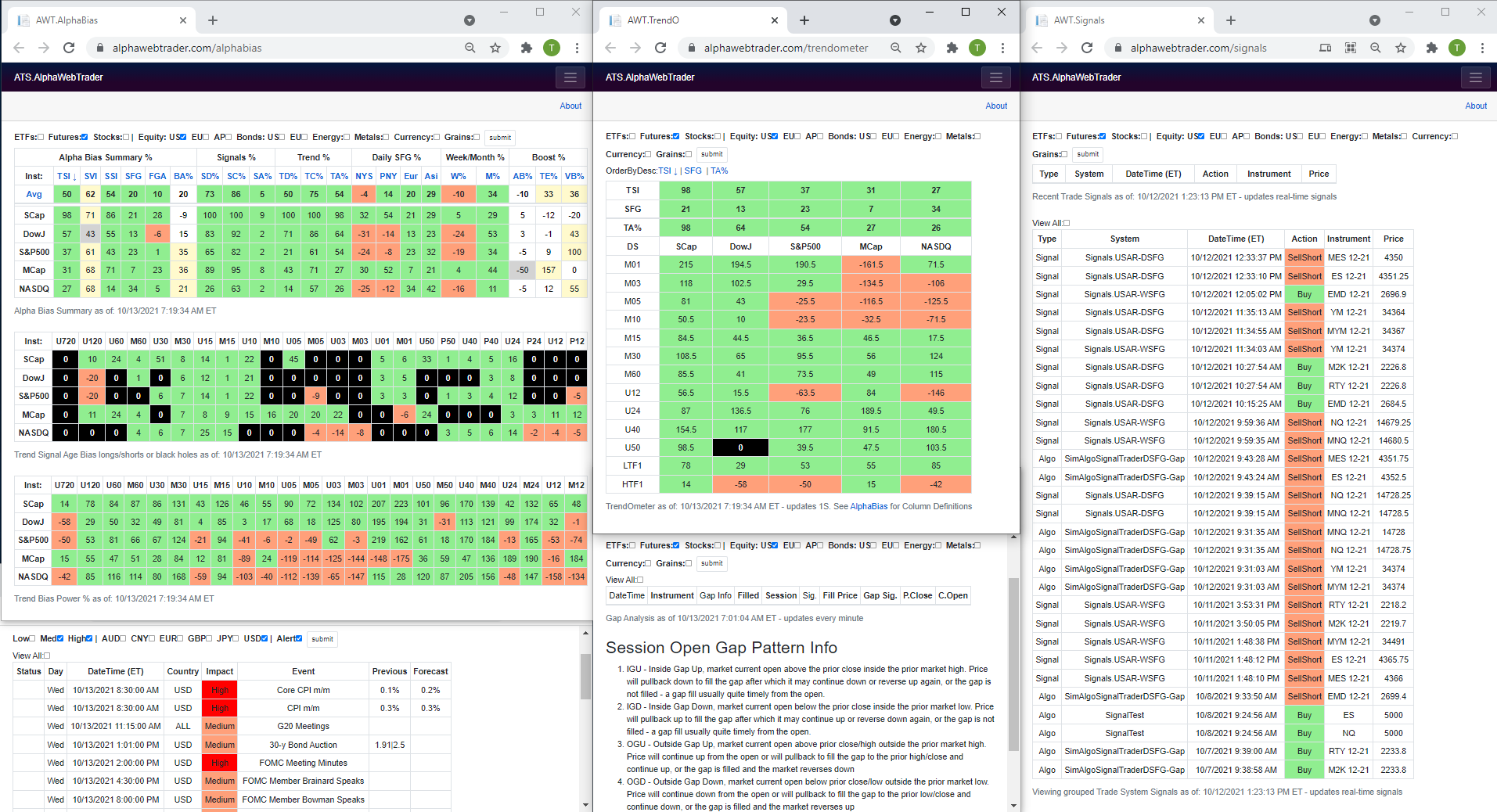
AlphaWebTrader extended the ATS ecosystem beyond the NinjaTrader desktop. AWT provides web, desktop, and mobile access to market information, technical analysis, algorithmic signals, higher-timeframe context, correlations, market states, trade zones, and supporting intelligence.
AFT8 and AWT perform different but complementary roles. AFT8 is the specialist NinjaTrader execution, automation, order-management, and trade-management environment. AWT provides broader market context, confirmation, web access, mobile access, and cloud-connected information that can assist the trader before authorizing or enabling an AFT8 opportunity.
The Current Algo Trading Systems Ecosystem
The modern ATS solution is not presented simply as a trading robot that a customer installs and leaves unattended. It is an integrated trader-development and trading-technology ecosystem designed to help serious traders build a controlled and repeatable operating process.
AFT8: Execution, Automation, and Trade Management
AFT8 supplies the local NinjaTrader trading engine. Traders can choose an algorithm baseline, configure risk, define direction, select an automation level, and allow the system to manage precision-sensitive and repetitive execution tasks.
AWT: Market Context and Confirmation
AWT supplies the wider technical and informational view. Traders can assess trend, momentum, index relationships, market state, levels, session conditions, and algorithmic opportunities before authorizing an AFT8 trading state.
ATS AI Trading Copilot
The ATS AI Trading Copilot provides an intelligence and educational layer. It can help organize market information, explain trading states, summarize technical context, and identify considerations that may be relevant to the trader’s prepared plan.
The AI Copilot does not remove trader responsibility, provide financial advice, or guarantee a trading outcome. It supports a more structured interpretation of AFT8, AWT, market context, risk management, and the ATS hybrid methodology.
ATS VIP Trading Group and Live Market Trading Zone
The ATS VIP Trading Group brings the technology and methodology into the live market. Traders can attend the Trading Zone to observe preparation, market structure, algorithm states, trade zones, directional considerations, risk discussions, and the practical differences between manual, semi-automatic, hybrid, and fully automatic operation.
The purpose is not to copy every action. Traders attend to understand the software, recognize the potential and limitations of each trading mode, and learn how to create their own rules, states, filters, and operating plans.
ATS Trader Fast Track
Fast Track provides structured onboarding for traders who need help moving from software installation to an operational workflow. It covers NinjaTrader setup, AFT8 and AWT configuration, the ATS hybrid method, baseline workspaces, VIP Group orientation, AI Copilot usage, risk controls, and development of an initial trading plan.
ATS VIP Mastery
VIP Mastery provides a longer structured development path for traders seeking dedicated assistance applying the ATS ecosystem to prop-firm, funded-account, or personal live-account objectives.
Mastery is designed to develop the trader as the operator of the technology. It is not based on handing the customer a secret configuration or claiming that one automated setting will work indefinitely in every market condition.
The Recommended ATS Development Path
- Discovery: Review trading experience, objectives, available session, account type, instruments, preferred automation level, technology requirements, and suitability for the ATS ecosystem.
- Installation and orientation: Configure NinjaTrader 8, AFT8, AWT, the selected workspace, account connections, and associated ATS resources.
- Structured simulation: Learn the signals, controls, trade management, session routine, platform behaviour, risk process, and emergency procedures.
- Hybrid specialization: Focus on a defined instrument, session, workspace, setup, and repeatable trading plan.
- Performance review: Use statistics, screenshots, and a trading journal to identify whether execution and decision-making are becoming consistent.
- Controlled progression: Consider the smallest suitable prop evaluation or live position only after demonstrating operational and risk discipline.
- Advanced automation: Explore attended or unattended fully automatic operation only after developing the necessary evidence, technical knowledge, capital, diversification, infrastructure, and monitoring processes.
Lessons from the Evolution of Hybrid Trading Technology
- A strategy that can place an automatic order is not necessarily a complete unattended trading system.
- Order execution, recovery, continuation, platform state, position state, and operational safety are as important as the entry signal.
- Human intervention is not automatically a failure of automation; when structured correctly, it is a designed component of the system.
- Backtesting does not remove live execution risk, slippage, disconnections, behavioural mistakes, or market-regime changes.
- A reusable technical framework can support several independently branded commercial products while each product remains distinct.
- White-label development enables specialist vendors to combine their signals, brand, and methodology with an established technical engine.
- Traders require education, onboarding, risk processes, market context, review procedures, and platform competence in addition to software.
- AI is most useful when it organizes and explains information while the trader retains responsibility for decisions and risk.
- The most advanced automation mode is not automatically the correct operating mode for every trader or account.
From MTDS and QuadroBase to AFT8, AWT, AI Copilot, and Mastery
The history of MicroTrends and Algo Trading Systems LLC shows a continuous development path rather than the sudden appearance of a new automated trading product.
The early NinjaTrader frameworks introduced real-time operator control. MTDS7 created a reusable commercial strategy engine. Licensed and white-label projects demonstrated how framework technology could support independently branded systems. BWT Precision AutoTrader 7 applied the earlier MTDS architecture. ATS QuadroBase recreated the foundation for NinjaTrader 8. BWT Precision AutoTrader NT8 demonstrated that QuadroBase could power a complete commercial NinjaTrader 8 product.
AFT7 advanced API-based hybrid control, while professional portfolio-system research developed the continuation, recovery, allocation, and operational foundations required for AFT8.
Today, AFT8 supplies the execution and automation environment, AWT supplies broader technical context, the AI Copilot helps traders interpret information, the VIP Trading Group demonstrates the methodology in live markets, Fast Track provides structured onboarding, and VIP Mastery helps traders develop a personalized operating process.
The result is not simply an automated trading strategy. It is a complete hybrid trading ecosystem designed around the relationship between the trader, the algorithm, NinjaTrader, the market, the account, and risk.
Explore the Latest NinjaTrader Hybrid and Automated Trading Technology
This article documents the MicroTrends development history and the evolution of its NinjaTrader frameworks, hybrid controls, white-label systems, QuadroBase technology, professional portfolio research, and Algo Futures Trader products.
For the latest generation of AFT8 technology for retail futures, day trading, prop trading, swing trading, hybrid algorithmic execution, and professional automated trade management, visit Algo Futures Trader NinjaTrader Automated Trading.
For a detailed comparison of manual, semi-automatic, interactive hybrid, attended automatic, and unattended automatic operation, read AFT8 Hybrid Versus Fully Automated Trading Systems.
Traders evaluating the platform can also review why traders choose Algo Futures Trader and learn more about the recommended NinjaTrader futures trading platform.